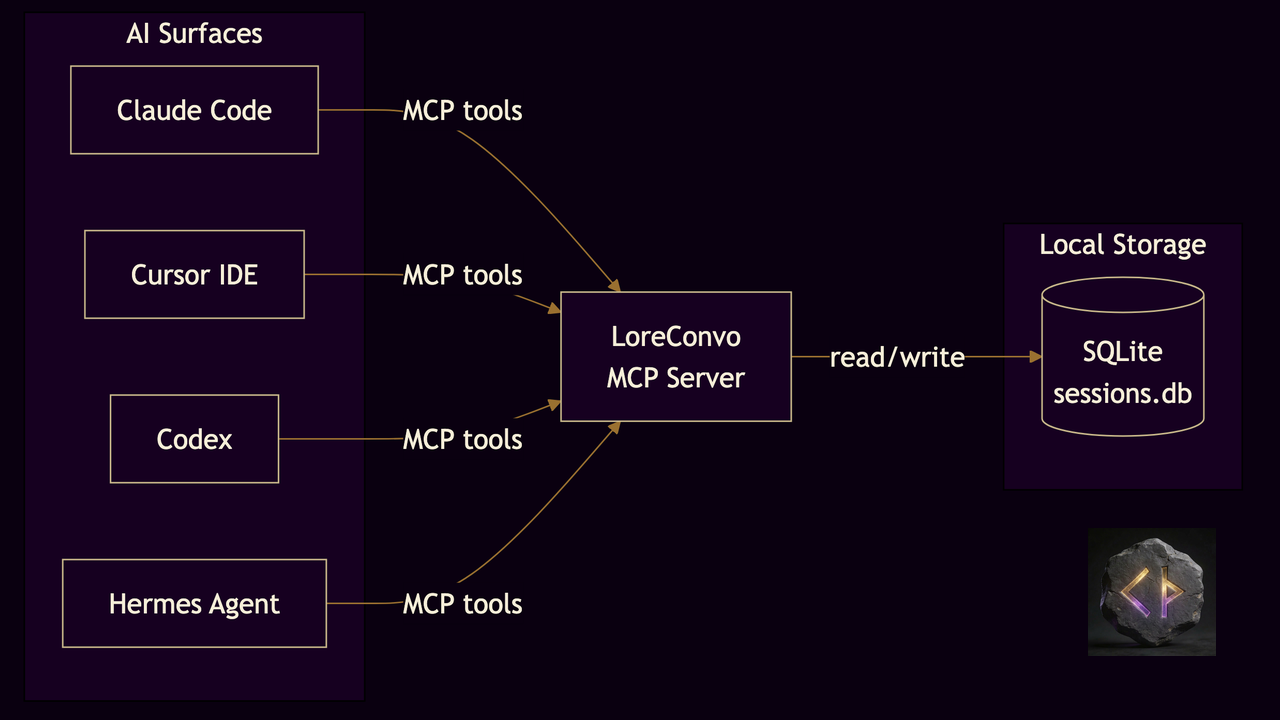
When a data engineer or AI practitioner moves from one prompt to the next, the context often evaporates. A model may have just worked through a tricky data pipeline, but the next session starts with a blank slate, forcing you to copy-paste snippets, re-type configuration, or rebuild the mental map of decisions you just made. The friction adds up, especially when you are juggling multiple development surfaces -- Claude Code, Cowork, the Codex desktop app, Cursor IDE, and Hermes Agent. What if the memory that powers those sessions could live in a single portable file that follows you across tools, projects, and machines?
The missing piece in modern LLM workflows
Large language models excel at reasoning, but they do not retain state between calls unless you explicitly provide it. In practice this means developers either store everything in external databases, write custom glue code, or accept that each new session starts from zero. External databases introduce latency, require network access, and add operational complexity that many engineers would rather avoid. Custom glue code quickly becomes a maintenance burden, especially when you need to support several IDEs or agents.
The result is a fragmented experience: a useful insight captured in one surface is invisible to the next, and the effort to reconstruct that insight grows with each handoff. The community has begun to talk about "MCP memory" and "session-persistence servers" as a way to standardize how LLM-driven tools keep track of work. Yet the concept still lacks a clear definition, a reference implementation, and a place in the ecosystem's taxonomy. Without a concrete example, the idea remains abstract, and tool makers are left guessing how to build reliable, portable memory layers. That is the gap a curated category would fill.
LoreConvo as the reference implementation
LoreConvo was built to answer exactly that need. It provides a local-first memory backend that works as a native MCP server on every major surface that supports the MCP protocol. A single .mcp.json configuration file placed in a project directory enables Claude Code, Cowork, the Codex desktop app, Cursor IDE, and Hermes Agent to read and write sessions without any additional setup. Because the storage is a single SQLite file that lives on your machine, you retain full ownership of the data, can back it up with any file-sync tool, and move it to a new machine without re-creating accounts or re-authorizing services.
Cross-surface session memory means that a conversation you start in Claude Code can be recalled automatically when you open the same project in Cursor IDE. The auto-load hook runs at the beginning of each session, pulling in the most relevant prior context based on project tags, skill history, and linked sessions. At the end of the session, the auto-save hook fires without any user action. It extracts a heuristic summary: a brief description, the decisions made, the tech-stack facts discovered, and any open questions the model signaled. Open-question capture is heuristic -- when the session contains enough signal the hook records the question, otherwise it is omitted. If you want a deeper look at how this compares to Anthropic's built-in memory approach, the four-way comparison post covers it in detail. And if you are wondering whether local-first storage creates operational overhead, this post on local-first agent memory addresses that directly. Saved data is stored locally, and you can edit or delete any entry through the memory inspection UI.
The free tier gives you fifty sessions, full-text search, and export/import to explore the workflow. Pro removes that limit and adds team memory -- export selected sessions to JSON and import them on a teammate's machine with no server required. Pro also unlocks related-session discovery, which combines keyword co-occurrence with semantic similarity to surface sessions likely to help solve a new problem. A memory consolidation tool distills recent history into a digest injected at session start, so you arrive with context rather than hunting for it.
All of this is exposed through 39 MCP tools -- each callable from any supported surface -- covering session management, onboarding, usage stats, related-session discovery, and memory inspection. The tools are composable, so you can build custom pipelines that fit your workflow without writing glue code.
Why a curated category matters
Having a concrete reference implementation clarifies what "MCP memory" and "session-persistence server" actually mean in practice. It shows the concept is not just a theoretical abstraction but a set of interoperable features that can be measured, compared, and improved.
When the community adopts a curated category, standardized expectations follow naturally. Developers know that an MCP-compatible memory server will provide cross-surface session recall, local ownership of data, and a set of management hooks -- which reduces the friction of evaluating new tools. Tool makers can target a well-defined API surface instead of reinventing storage layers for each product, leading to faster onboarding and more consistent user experiences.
Clear benchmarking becomes possible too. With a reference implementation, performance, storage efficiency, and feature completeness can be measured objectively. Rankings can then focus on real differences rather than vague marketing claims. Because LoreConvo stores data in a plain SQLite file and offers Python fallback scripts for environments without MCP support, developers can also extend the system, write custom exporters, or integrate with other data pipelines without waiting for a vendor update.
Local-first storage reduces risk in a more fundamental way: no hidden cloud dependencies, no surprise data-loss events, and full auditability. Teams can comply with internal data-governance policies while still enjoying the convenience of persistent LLM memory.
By positioning LoreConvo as a fully featured, cross-vendor MCP memory server, the ecosystem gets a solid foundation on which to build the next generation of AI-augmented development tools. The category will evolve, but the core principles -- portable local storage, automatic context injection, and a rich set of management hooks -- provide the benchmark.
Ready to try a memory layer that follows you across Claude Code, Cowork, Codex, Cursor, and Hermes Agent? Explore the full toolset or get posts like this weekly.
Related reading:
- AI Memory for Claude: An Honest 4-Way Comparison -- the hub post for this cluster, comparing the memory primitive, claude-mem, mem0, and LoreConvo
- LoreConvo: Coordination, Portability, No Lock-In -- the sibling post on why a memory layer has to travel across tools without locking you in