The time to find out whether you can get your data out is not the day you want to leave.
Every agent memory layer you use is accumulating context you may eventually need to move -- to a different tool, a different machine, a different vendor, or a departing teammate. This post is about doing the export while everything is still working fine, treating portability as a hedge rather than an emergency measure.
This argument holds even if you are not using LoreConvo. Whatever tool you use for agent memory, run its export today and see what you actually get. The ecosystem is moving fast, import/export protocols are gaining traction across frameworks, and there is still no agreed-upon standard. The property that survives a platform shift is portability -- and you cannot know whether you have it until you have tested the path.
What a real export produces
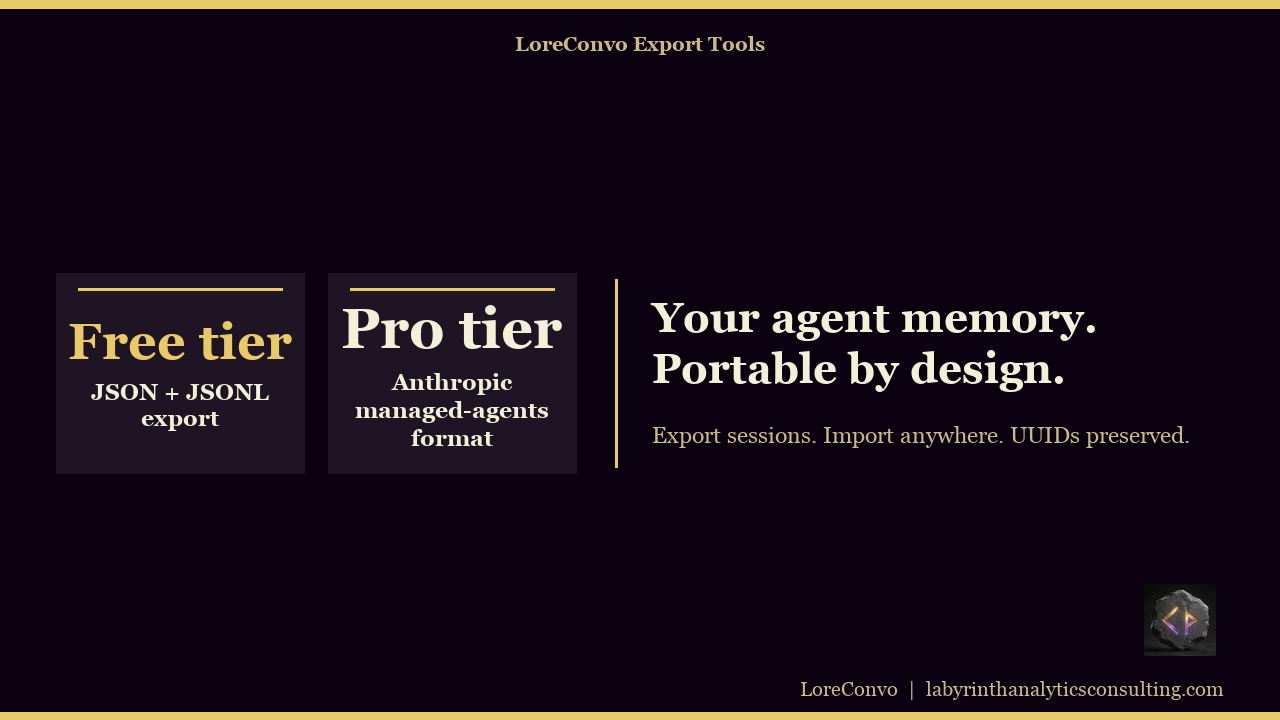
LoreConvo's export_sessions is a free-tier MCP tool. It writes your session records to a JSON or JSONL file that you control. Each record in the export contains the session's title, summary, surface, project, tags, skills used, key decisions, open questions, and the start and end timestamps. The unique session UUID travels with the record.
That last point is what makes re-import idempotent. When you call import_sessions on an export file, the tool checks each incoming UUID against what is already in the local database. If the session already exists, it is skipped without modification. Running the import twice produces the same result as running it once, so there is no risk in making exports a regular habit.
The round-trip is straightforward: export to a file, copy it to a new machine or a backup location, and call import_sessions pointing at that file. The new environment picks up where the old one left off. Because the format is plain JSON, you can also inspect the file in any text editor or load it into a script -- there is nothing opaque about what was saved.
The export_sessions tool gives you several options for scoping the export: by project, by tag, by date range, or by a list of specific session IDs. For most day-to-day backup routines, exporting by project is the most useful: it keeps each project's knowledge self-contained and makes it easy to hand off a focused subset to a teammate.
The managed-agents bridge for Pro users
If your organization uses Anthropic's managed-agents platform, LoreConvo Pro includes export_for_anthropic, which translates your local sessions into the anthropic-memory-v1 format. This creates a file shaped to match what Anthropic's memory API expects, giving you a direct path from a local SQLite store to a managed service.
There is an honest caveat here: the field mapping is preliminary, pending Anthropic's beta schema stabilization. The tool logs any unmapped fields so you can catch gaps before a migration becomes urgent, and it is designed to fail gracefully rather than silently drop data if the target schema evolves. The managed-agents export respects the same idempotent guarantees as the free tools, so you can include it in a regular backup run.
This is not a universal portability standard -- no such thing exists yet. It is a practical, opinionated bridge between two systems, and the disclaimer in the tool's output is intentional. Use it to reduce migration friction, not to remove migration planning entirely.
Building the habit
A one-off export is better than nothing. A regular export is what actually protects you. The practices that make this durable are simpler than they sound.
Making exports part of your weekly routine takes about as long as a git commit. If you are already storing project knowledge under a consistent project tag, scoping the export to that tag keeps the file compact. A date in the filename -- loreconvo_export_20261012.json -- is enough to make the right version findable later.
Testing the import path once is worth the ten minutes it takes. Spin up a fresh environment, point import_sessions at a recent export, and confirm that the sessions come back intact. Doing this when nothing is on fire means you will not discover a schema surprise for the first time when you actually need to migrate.
For Pro users who have already adopted Anthropic's managed-agents platform, running export_for_anthropic on a recent export gives you a current bridge file in reserve. The Anthropic schema is still evolving, so treating this as a periodically refreshed artifact rather than a one-time migration is the right posture.
The effort is small -- a command or a click -- and the result is a portable record you can carry across machines, teams, and providers. The question is not whether you will ever need it; it is whether you will have run the test before you do.
Start before you need to
The point of building a local-first memory layer is that you stay in control. Exporting regularly is how you keep that promise to yourself. With export_sessions and import_sessions on the free tier, you have everything you need to make your agent memory as portable as your code.
Explore the full LoreConvo toolset at /tools, or read how the local-first approach holds up against other memory options in the four-way memory comparison. For the case behind building locally rather than relying on a hosted layer, see why I built local-first agent memory.
Get posts like this delivered weekly: subscribe to Dispatches from the Labyrinth.