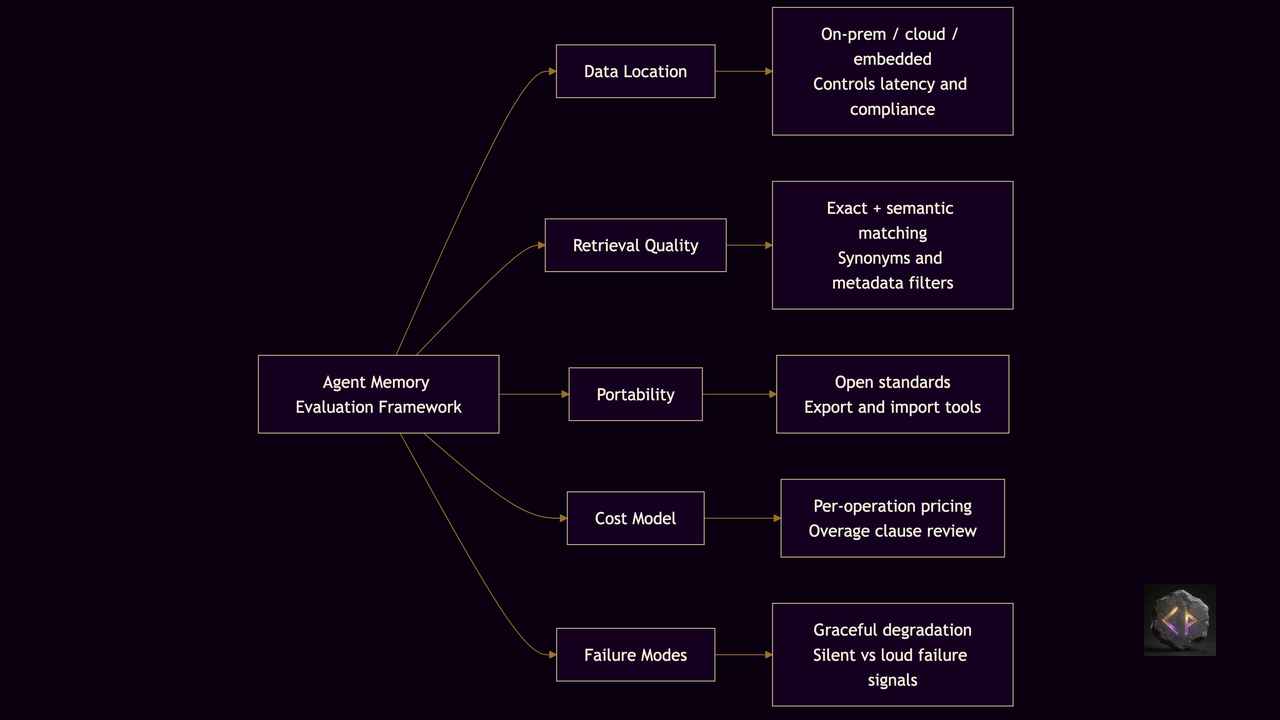
When you start building autonomous workflows, the ability of an agent to remember matters just as much as its ability to compute. A few months ago most teams treated memory as a nice-to-have add-on; today it is a table stake. If an agent cannot reliably store facts, retrieve them on demand, and survive a restart without losing context, the whole system becomes fragile. This guide walks through the concrete criteria you should use to evaluate agent memory, shows how to test retrieval quality on your own hardware, and highlights the red flags that often hide behind polished demos.
Why memory has moved from novelty to necessity
Early prototypes of conversational agents relied on a single request-response cycle. The model received a prompt, generated an answer, and discarded everything. That approach works for isolated queries but breaks down the moment you need continuity -- a data pipeline that must remember which tables have already been cleaned, or an assistant that must keep track of open tickets across sessions.
When memory becomes a core component, three practical shifts follow. Stateful pipelines can avoid redundant work: an agent that knows a file has already been processed can skip re-ingestion, saving compute cycles and reducing cost. User trust improves when the system recalls preferences or previous decisions, because a data engineer who asked an agent to flag outliers last week expects the same flagging logic to apply today. Failure handling also becomes more transparent: if an agent crashes, a persistent memory store lets it resume where it left off instead of starting from scratch.
Because memory is now expected rather than optional, the market has responded with a variety of storage back-ends, retrieval algorithms, and integration patterns. Not all of them are created equal, and the choice you make will affect performance, cost, and long-term flexibility.
Core criteria for evaluating agent memory
When you compare solutions, treat each criterion as a dimension rather than a checkbox. A strong offering will score well across the board; a weak point in any one area can become a hidden cost later.
Data location matters because it determines latency, compliance, and data residency. On-premise disks, a managed cloud database, and an embedded local file each carry different tradeoffs. Knowing exactly where the memory lives -- and who controls access to it -- is a prerequisite before any other evaluation can be meaningful.
Retrieval quality is whether the system returns the right piece of information when asked. This includes relevance ranking, handling of synonyms, and the ability to filter by metadata such as timestamps or source tags. Retrieval quality is also the criterion most likely to be obscured by a demo, which is why hands-on testing matters so much (see the next section).
Portability is whether you can move the memory store to another environment without rewriting large portions of code. Look for open standards, export and import tools, and APIs that are not tied to a single vendor's ecosystem. A memory layer with no export path is not a memory layer -- it is a lock-in mechanism.
Cost model needs to be understood at the operation level, not the headline level. Some services charge per gigabyte stored, others per read-write operation, and a few embed costs in compute pricing. Understanding the pricing granularity lets you forecast expenses as usage grows rather than discovering an overage clause on your first large run.
Failure modes reveal how the system behaves when the store becomes unavailable, when data corruption occurs, or when network latency spikes. Robust solutions provide graceful degradation, retry strategies, and clear error signals. A memory layer that fails silently -- reporting success while the data never persisted -- is worse than one that fails loudly.
How to test retrieval quality yourself
Even with complete vendor documentation, the most reliable way to confirm a memory layer meets your needs is to run a focused test before committing to a larger rollout.
Start by populating the store with 200-300 entries that mimic the kind of facts your agents will handle -- a mix of short key-value pairs, longer text snippets, and metadata such as timestamps, source identifiers, and tags. The corpus does not need to be large; it needs to be representative.
Then write 20-30 natural-language queries that cover exact matches, partial matches, synonym usage, and metadata filters. The most revealing test is also the simplest: ask the tool for something using words that are not in the document you want it to find, and check whether it returns it. A store that relies on keyword matching will fail this query; a store with genuine semantic understanding will not. Run the same queries against a plain keyword search on the same corpus to establish a baseline. The gap between the two tells you what the memory layer is actually adding.
For each query, record the returned result, the latency, and any error codes. Score relevance on a simple scale -- incorrect, partially correct, fully correct -- and note whether the result arrived within an acceptable latency threshold for your use case. Look for systematic gaps: does the store miss synonyms? Does it ignore timestamps when you ask for "most recent"? Does latency increase sharply with larger result sets? Then run the same queries under simulated concurrent load to see whether quality degrades when multiple threads are hitting the store.
The whole test can be built and run in a few hours. The result is a concrete, reproducible picture of retrieval quality that you can compare against future upgrades or alternative stores.
Red flags
The market is moving fast, and many solutions present a polished front while hiding limitations that surface under real-world pressure. A few patterns are worth naming explicitly.
Silent failure is the most dangerous: the system reports success, but the data never persisted, or retrieval returns a stale value without an error. Verify writes with a read-after-write check and make sure the API response includes explicit confirmation rather than a generic 200. Related to this is limited observability -- without logs, metrics, or health checks that surface read-write latency and error rates, you cannot build reliable monitoring or alerting, which means you will learn about silent failures from your users rather than your dashboards.
Opaque storage is another signal worth taking seriously. If the provider does not disclose where the data resides, you lose control over compliance and latency expectations. Pair this with a missing export path and you have a combination that makes migration from the platform a major engineering project rather than a routine operation.
Hidden cost spikes are harder to spot in advance but common. Review the pricing sheet for any overage clauses related to versioning, backup, or high-throughput reads. If the documentation does not specify replication factor, backup frequency, or recovery time objectives, treat that as a gap that needs to be answered before you rely on the store in production.
Finally, watch how the system handles metadata. When tags, timestamps, or custom fields are stripped or altered during storage, downstream agents lose the context they need to make correct decisions. A store that degrades metadata quietly is one that will generate hard-to-debug retrieval failures later.
Making the decision
Evaluating agent memory is less about picking the flashiest feature and more about confirming that the store aligns with your operational constraints. Build a scorecard from the criteria above, run the retrieval quality test on your own data, and apply the red flag checklist before you sign anything.
If you want to go deeper -- or if the evaluation surfaces tradeoffs that are not straightforward to resolve -- that is exactly the kind of decision where an outside perspective helps. At Labyrinth Analytics we have helped data engineering teams design, test, and deploy memory solutions across a range of architectures and scale requirements. If you are still building your evaluation framework, our earlier post on hiring agentic AI consultants covers the same vendor-neutral approach applied to the consulting engagement itself, and the four-way memory comparison shows how we applied these criteria against concrete tools. You can learn more about what a deeper engagement looks like at /services or reach out directly to talk through your specific situation.