
When a data engineering team first hears "LangGraph implementation," the mental picture is often a black-box sprint that delivers a finished agent overnight. In reality the process is a series of focused steps, each with clear hand-offs and a realistic timeline. Understanding what the engagement looks like helps you decide whether you need a consulting partner, what you will own at the end, and how the work fits into your broader roadmap.
What Happens in Discovery
The first week is all about listening. We meet with the engineers, product owners, and domain experts who will feed data into the graph. The goal is to surface the business problem, the data sources, and the performance expectations. We ask concrete questions: which downstream systems will consume the graph's output, what latency constraints exist for inference, and how often does the underlying data change. These answers shape a short discovery document that lists the success criteria, the risk factors, and the scope that can be addressed in a single engagement.
If the problem is purely exploratory -- a proof of concept that doesn't need integration with production pipelines -- then a consulting engagement may not be the right call. In those cases we often point teams to open-source examples and community forums, letting them iterate on their own before spending on outside help. When discovery reveals a clear integration point and measurable outcomes, we move forward. The client receives a concise brief that outlines the agreed objectives, the data assets in play, and the expected deliverables. That brief becomes the contract's foundation.
The Architecture Sketch
With the brief in hand, we draft a high-level diagram that maps data ingestion, transformation, graph construction, and inference serving. The sketch is deliberately lightweight -- it doesn't dive into line-by-line code, but it identifies the key components and how they connect. A data lake or warehouse connector extracts raw records into a preprocessing pipeline that normalizes and enriches them. The LangGraph definition encodes nodes, edges, and state transitions. An inference API exposes the graph's decisions to downstream services.
Each component comes with a technology recommendation that aligns with the client's existing stack. If the team already runs batch processing at scale, the loader pattern follows the same pattern. If the inference service must run containerized, we outline the deployment approach up front rather than discovering the constraint in week three.
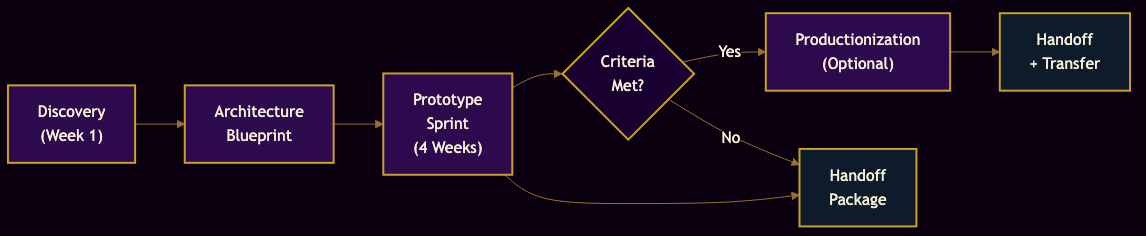 A typical engagement moves through Discovery, Architecture, a fixed-scope Prototype Sprint, and optional Productionization -- with a documented Handoff Package at each exit.
The blueprint also includes a risk register. Data drift, graph definition versioning, and execution observability are the concerns that bite teams later, and naming them early lets the client see exactly where the consulting effort will focus -- and where they'll need to maintain the system after handoff. At the end of this phase the client has a documented architecture diagram, a list of recommended tools, and an implementation plan broken into weekly milestones. The scope is fixed: we agree on what will be built, not on an open-ended feature list.
The Fixed-Scope Prototype Sprint
The prototype sprint is a four-week, time-boxed effort that turns the blueprint into a working proof of concept.
In the first week we connect to the client's source systems, extract a representative sample, and run the preprocessing steps defined in the blueprint. Week two is graph definition and validation: using the LangGraph SDK, we encode the nodes and edges that represent the business logic, run unit tests, and verify that the graph produces the expected state transitions on the sample data. Week three wraps the graph in a lightweight API, containerizes it, and deploys to a test environment where simulated downstream calls verify latency and correctness. Week four ends with a demo, a walkthrough of the codebase, and a handoff package.
The handoff package is the deliverable the client owns when the sprint ends. It contains source code in a Git repository with clear commit history, configuration files for the data pipeline and inference service, a runbook describing how to start, stop, and monitor the system, and a set of automated tests the team can extend as the graph evolves. All work runs at a fixed price, so the total cost is known before a line of code is written. The sprint produces a validated foundation, not a production-grade system -- and that distinction matters when setting expectations with stakeholders.
Productionization
If the prototype meets the success criteria, productionization is the natural next step. This phase is optional and scoped as a separate engagement. The work involves scaling the ingestion pipeline to handle full-volume loads, adding monitoring and alerting for graph execution latency and error rates, implementing version control for graph definitions so rollbacks are safe, and integrating with the client's CI/CD system so graph updates are automatically tested and deployed.
When we move into productionization the client retains ownership of all code and data. The final deliverable is a self-contained repository that the client's own team can operate. We also run a knowledge-transfer workshop that walks engineers through the deployment process, troubleshooting steps, and best practices for maintaining a stateful agentic system over time. If the prototype already satisfies a narrower use case, productionization is optional. The handoff package from the sprint is sufficient for the client to run the graph in a limited environment, and we remain available for targeted support.
When You Might Not Need a Consultant
Not every LangGraph project requires outside help. If your team has deep experience with graph-based AI, a clear data pipeline, and the ability to write and test Python code, you can likely prototype internally. A consulting engagement adds the most value when the problem spans multiple data domains and needs a unified architecture, when you need a rapid prototype that aligns with business stakeholders on a fixed timeline, when your team is new to the specific patterns of stateful agentic workflows, or when you want an independent risk assessment and a documented handoff package you know you can hand to a new engineer six months from now.
In cases where a full engagement isn't justified, a short discovery session can still be useful. A high-level review of your plan, identification of common pitfalls, and a curated list of resources can help you move forward without committing to a longer project.
What to Read Next
For a look at a recent implementation -- a 19-node finance pipeline that runs in production -- see the finance pipeline case study. If you are still deciding whether to hire outside help at all, how to evaluate an agentic AI consultant covers the questions to ask before signing anything. The broader context for when LangGraph is the right tool lives in the LangGraph hub post.
When you are ready to talk about scope, timeline, and cost, the details are at /services. To start a conversation directly, reach out through /contact.