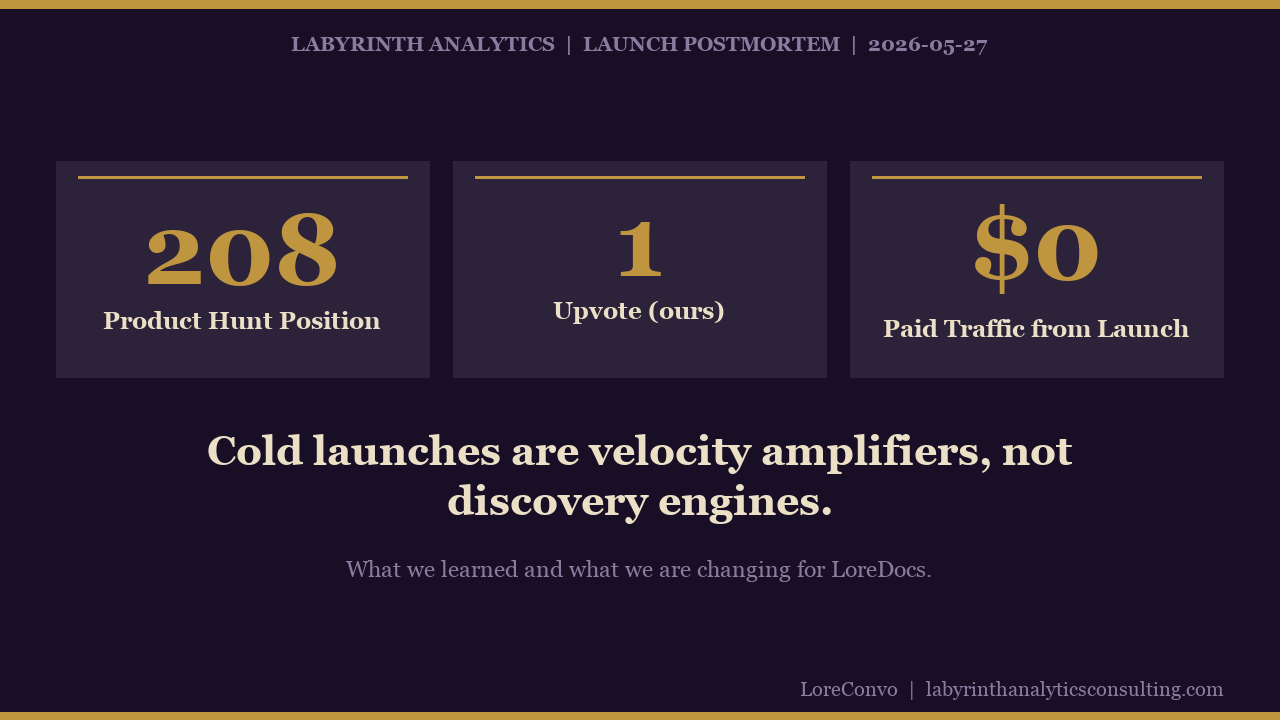
On May 27, 2026, we launched LoreConvo on Product Hunt and submitted a Show HN at the same time. The idea was a combined strike: two audiences, two streams of attention, one day of momentum. By the end of the day, LoreConvo sat at position 208 on Product Hunt with one upvote -- from Debbie's personal account. The Hacker News submission generated no measurable traffic.
This post is an honest accounting of what happened, why it happened, and what we are changing.
What We Did
LoreConvo is a local-first Claude plugin that saves session context to a SQLite file on your machine. It gives Claude Code, Cursor, and other MCP-compatible tools a persistent memory layer: auto-saved at session end, auto-loaded at session start, searchable by full text. The Pro tier adds semantic search, LLM-quality summarization, and team session sharing via JSON export and import. The free tier stores up to 50 sessions with no cloud dependency.
We had been building LoreConvo since early 2026. By the time of launch, it was installable via pip and in use internally by our own team as coordination infrastructure. The technical foundation was solid. We decided May 27 was the right time to go public.
The launch plan was a two-platform simultaneous post. Product Hunt gets a curated feed of developer tools; Hacker News reaches practitioners who read the source. The theory was that momentum on one would reinforce the other, and a day of combined attention would establish an initial user base that subsequent content could build on.
What Happened
The Product Hunt post went live at midnight Pacific. By morning it was at position 208. It received one upvote -- from the personal account that created the submission. Our company page on Product Hunt had been locked by anti-spam controls before launch and could not vote or comment. The company page had zero reachable supporters.
The Hacker News submission went up on the morning of May 27. The thread never gained traction. No measurable traffic arrived from HN during the day.
The combined launch generated a position of 208 and one vote. That is not an execution failure. That is the expected outcome of launching into a void.
The Honest Diagnosis
Product Hunt and Hacker News are not discovery engines. They are velocity amplifiers. The distinction matters because it changes what you need to bring to the table.
A discovery engine surfaces tools to people who have never heard of them. SEO does this. Long-form technical content does this. A well-timed blog post on dev.to can introduce a tool to a data engineer who was not looking for it but immediately recognizes the problem it solves. These channels generate new awareness from scratch.
A velocity amplifier takes existing momentum and accelerates it. On Product Hunt, the first-hour upvotes determine the day's ranking. Those first-hour upvotes come from your existing network: people who already know what you built, trust your judgment, and are willing to spend thirty seconds clicking upvote. Hacker News works the same way. If the first ten comments are substantive, the post gains enough points to stay on the front page. Those ten comments come from people who have already used the tool, or at least read your work enough to have an opinion.
We had neither. We had not yet built an engaged audience in the places that matter for a developer tool -- a following on LinkedIn, a warm community on Discord, an email list, a presence on dev.to that could pre-warm interest. We had a technically capable product and no one positioned to amplify it.
The result was position 208 and one vote.
What We Would Do Differently
The honest answer is: we would build the audience first.
Not followers for the sake of a launch. An audience means people who have read your writing, found it useful, and opted into receiving more of it. For a developer tool targeting data engineers and AI practitioners, that audience lives in a few specific places. It reads long-form technical posts on dev.to and Hacker News. It follows individuals -- not companies -- on LinkedIn. It shows up in Discord communities for specific frameworks, not generic AI subreddits.
Building that audience takes six to twelve weeks of consistent technical output. The cadence matters less than the quality and specificity. A post about why SQLite is the right backend for local-first agent memory will reach a narrower but more qualified audience than a post about AI productivity. A case study showing how a team of scheduled agents coordinates via LoreConvo session exports lands with practitioners who have the same problem.
On framing: a launch announcement is weak content. "We launched a plugin" is not a reason for someone to pay attention. A technical walkthrough of how the auto-save hook works, what it captures (decisions and artifacts, extracted by heuristic), and why local storage beats a cloud backend is a reason to pay attention. The announcement should come after the content has already established credibility.
On narrowing the focus: we positioned LoreConvo as a general Claude plugin, which made it harder to explain in thirty words. A more specific framing -- "persistent session memory for Claude Code, installable in one command" -- would have made the product hunt description clearer and the HN title more likely to be clicked by the right people.
On the PH timing: the algorithm is ruthless about hour-one velocity. Without a network that will vote and comment in that first window, a midnight launch produces the outcome we got. The right move is to have twenty people ready to upvote and comment at launch time, not to hope that the algorithm discovers you on its own.
What We Are Doing Next
Our focus now is a distribution rebuild, not a relaunch.
The first priority is long-form technical content. We are targeting dev.to and the Labyrinth Analytics blog with posts that solve concrete problems: why session memory matters for multi-agent systems, what the cost of context loss actually looks like in production, how LoreConvo's local-first model differs from cloud-backed alternatives. These posts do not mention launches. They demonstrate the problem and the tool that solves it.
The second priority is LinkedIn. Personal posts in a technical voice -- sharing specific decisions, measurements, and lessons from building and running an agent team -- reach practitioners who already trust the signal. The Labyrinth Analytics company page carries the same content in a product voice.
The third priority is BlueSky, where the technical developer community is growing and the signal-to-noise ratio is still relatively good. Short-form posts that link to the blog content will create a rhythm without requiring a separate content stream.
What we are not doing: we are not relaunching LoreConvo on Product Hunt. The algorithm has fingerprinted it. We are not posting to generic AI subreddits, which in our experience attract self-promotion rather than practitioners. We are not rushing a second launch.
LoreDocs, the companion knowledge vault plugin, is already available. Its dedicated launch is deliberately sequenced later -- behind the audience-building work -- so it launches into momentum instead of a void, applying the lessons LoreConvo taught us.
What the Numbers Were Good For
Position 208 is not a failure data point. It is a calibration point. It tells us exactly where we were in the distribution of effort required to matter on that platform: at the bottom, because we had not done the pre-work.
The LoreConvo codebase is solid. The auto-save hook captures session context without manual intervention. The FTS5 search finds relevant sessions instantly. The Pro tier's semantic search closes the gap on non-keyword queries. The team memory export lets multiple agents share context without a server. None of that goes away because the launch was quiet.
The lesson is not to build something better. The lesson is to build an audience first, then let the launch be what it was always meant to be: a signal boost for momentum that already exists.
We are starting that work now, and the data points will be in the writing as it goes out.
If you are building with Claude and want a persistent memory layer for your sessions, visit labyrinthanalyticsconsulting.com/tools. If you are running a multi-agent system and want to talk through the coordination architecture, reach out at labyrinthanalyticsconsulting.com/contact.