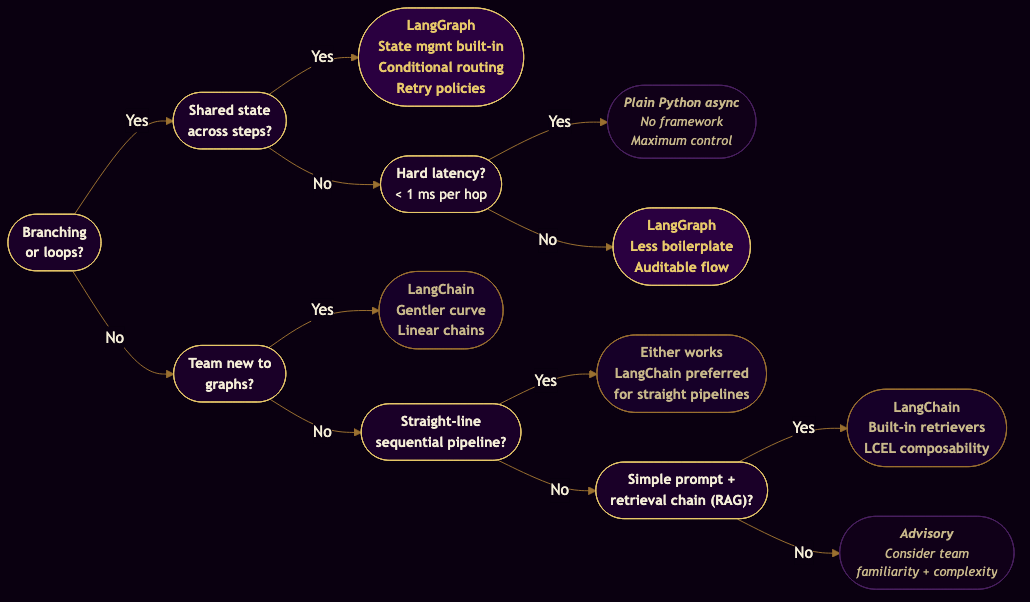
The data pipelines that power modern finance are getting longer, more dynamic, and more inter-dependent. A single trade-capture workflow can touch market data feeds, risk models, compliance checks, ledger updates, and downstream reporting -- all in a matter of seconds. When you build that workflow yourself, you quickly discover two competing pressures: you want a clear, reusable structure, but you also need to keep the codebase approachable for engineers who are comfortable with Python, async calls, and the occasional prompt-to-model loop.
That tension is at the heart of the LangGraph versus LangChain conversation in 2026. Both libraries stem from the same open-source lineage, yet they make different trade-offs around abstraction, state handling, and orchestration. This post walks through a decision framework for choosing between them -- when the graph abstraction is worth the extra complexity, and when a simpler chain or even a hand-rolled approach makes more sense. The guidance is anchored in a real-world finance pipeline I built for a client: a 19-node workflow that moves from raw market ticks to a daily profit-and-loss statement.
Understanding the core abstractions
LangChain introduced the idea of a "chain" as a linear sequence of steps: retrieve data, feed it to a model, post-process the output, and return a result. The chain model works well when each step has a single, well-defined input and output, and when the flow does not need to branch or loop based on intermediate results. In practice, a chain is just a Python class that calls a list of components in order.
LangGraph extends that idea by treating the workflow as a directed graph. Nodes still represent individual operations -- prompt calls, data fetches, transformations -- but edges can encode conditional routing, parallel execution, and explicit state passing. The graph runtime maintains a mutable state object that any node can read or write, and it can re-enter nodes when a loop condition is met. This makes it possible to model complex decision trees, retry policies, and multi-step reasoning without writing custom control-flow code.
The key difference, then, is that LangGraph gives you a built-in representation of control flow, while LangChain leaves that to the developer. If your pipeline is essentially a straight line, LangChain's simplicity can be a virtue. If you need branching, loops, or shared state across many steps, LangGraph's graph abstraction can reduce boilerplate and make the logic easier to audit.
When the graph abstraction earns its complexity
Conditional branching is central
If a model's answer determines which downstream step runs next, a graph lets you declare that rule once and let the runtime enforce it. In the finance example, a risk-score model decides whether a trade needs manual review. With LangGraph I defined a node that writes a "review_needed" flag into the shared state, and two downstream nodes that either route the trade to a compliance queue or continue to settlement. The branching logic lives in the graph definition, not in a series of if-else statements scattered across the code.
Loops and retries are required
Some data sources are flaky, and a simple retry loop can become noisy if you embed it in every chain. LangGraph allows you to attach a retry policy to a node, and the runtime will automatically re-enter that node up to a configurable limit. In the finance pipeline I needed to poll a market-data vendor until a price tick arrived within a tolerance window. The loop node handled the polling, timeout, and back-off without any extra scaffolding.
Shared mutable state across many steps
When multiple components need to read or update the same piece of information, passing that data through function arguments quickly becomes unwieldy. LangGraph's state object is a dictionary that any node can read or write. In the 19-node workflow, the state held the trade identifier, the latest market price, a risk flag, and a ledger entry ID. Each node contributed its piece, and later nodes could verify consistency without having to thread dozens of parameters through function signatures.
Parallel execution for independent sub-tasks
If two sub-tasks can run at the same time, a graph can express that relationship explicitly, and the runtime can schedule those nodes concurrently using async primitives under the hood. In the finance case, I fetched market data from two providers in parallel, merged the results, and only then proceeded to pricing. The graph definition made the parallelism obvious; the runtime handled the coordination.
When you see several of these patterns in a project, the graph abstraction starts to pay for itself. The upfront effort of defining nodes and edges is offset by reduced boilerplate, clearer visualizations, and easier testing of individual paths.
When a plain chain or custom code is a better fit
The graph's strengths become liabilities in the wrong context. For a straight-line pipeline with a single path from start to finish, adding a graph layer can feel like extra weight. A LangChain chain that calls a data loader, a prompt, and a formatter is easy to read and debug. In many batch-oriented jobs -- nightly data dumps or simple enrichment pipelines -- the linear model is sufficient and adding nodes and edges just adds surface area for errors.
Performance-critical sections are another signal to step back. The graph runtime introduces overhead for state management and node scheduling. In microsecond-latency scenarios, a hand-rolled async function chain may be the safer route. And team familiarity matters: introducing LangGraph means new concepts, new debugging tools, and a learning curve. If the team is already comfortable with LangChain and the project timeline is tight, sticking with the known tool reduces risk.
Finally, when each step works on its own slice of data and only the final result matters, a global state object is unnecessary. Passing explicit arguments keeps the data flow transparent and can make unit testing simpler. The graph adds the most value when many nodes need access to shared context; when they do not, it is overhead with no payoff.
Real-world example: a 19-node finance pipeline
A mid-size asset manager needed an end-to-end pipeline that ingested live market ticks, enriched them with risk metrics, performed compliance checks, executed trades, and produced a daily profit-and-loss (P&L) report. The business rules required several conditional paths: if a trade's risk score exceeded a threshold it must be flagged for manual review; trades involving illiquid assets need a secondary price verification step; any trade that fails a compliance rule must be routed to a remediation queue; and the P&L calculation must wait until all trades for the day are settled, but can start as soon as the first settlement completes.
Mapping those requirements onto a graph gave us a clear visual model. The 19 nodes were:
- fetch_market_tick
- normalize_tick
- compute_risk_score
- evaluate_risk_flag
- route_to_review_or_continue
- fetch_secondary_price (conditional)
- verify_price_tolerance
- compliance_check
- route_to_remediation_or_continue
- execute_trade
- record_ledger_entry
- update_settlement_status
- check_all_settled
- start_daily_pnl (parallel trigger)
- aggregate_trade_results
- compute_daily_pnl
- generate_report
- send_report
- archive_run_metadata
The graph definition captured the conditional edges between nodes 3-5, 6-7, 8-9, and 13-14. The runtime handled the parallel execution of node 6 only when the risk flag indicated an illiquid asset, and it automatically retried node 1 when the market feed timed out. Because the state object persisted across all nodes, each operation could read the accumulated context without threading parameters through every function call.
The long-term payoff came when a new compliance rule was added later in the year. We inserted a new node and rewired two edges -- no changes to the surrounding code were required. The graph also gave us a diagram to share with auditors showing exactly which paths a trade could take. If we had tried to implement the same logic with a linear chain, we would have needed nested if-else blocks, manual retry loops, and explicit context passing throughout. The code would have been longer, harder to read, and more fragile when the business rules changed.
Choosing the right tool
The choice between LangGraph and LangChain comes down to the structural complexity of the problem. When the workflow contains branches that depend on model output, loops or retries that benefit from a runtime scheduler, or many components that need to read and write shared state, LangGraph earns its overhead. When the pipeline is a single well-defined sequence with no branching or shared context, LangChain's simplicity wins -- and plain Python async code is always on the table when neither framework adds enough value to justify the dependency.
Team readiness is a real factor too. A well-understood chain that the team can debug in an afternoon often beats a graph that requires a week of ramp-up, especially in the early stages of a project when requirements are still shifting. One pragmatic approach is to start with a chain, identify the points where branching and state management create friction, and introduce the graph abstraction only when those friction points outweigh the learning cost.
Both libraries are actively maintained and integrate with the same ecosystem of LLM providers, vector stores, and data connectors. The decision is not about which tool is newer -- it is about matching the abstraction to the shape of the problem.
If you are evaluating whether a graph-based approach fits your data engineering challenges, or if you need help designing a robust AI-augmented pipeline, I work with teams at Labyrinth Analytics to do exactly that. Reach out through the contact page to start the conversation.
Related reading:
- Building a 19-Node LangGraph Pipeline -- the hub post for this cluster, covering the foundational design decisions
- LangGraph State and Observability -- how to instrument a running graph for production visibility
- Data engineering services and case studies