You Use Multiple Tools For Knowledge, And That Is The Right Call
Most of us working in technical fields have discovered that no single tool owns the entire knowledge landscape. You probably use Obsidian for your personal notes, NotebookLM to consume research documents, Google Docs for collaborative writing, and Confluence for team documentation. Each tool occupies a corner of your knowledge world. The question is not "which tool should I use?" but rather "which tool owns which part of the job?"
This confusion exists because most knowledge tools are designed to be general purpose -- they try to handle note-taking, research synthesis, collaborative editing, and reference retrieval all in one package. The result is that most are mediocre at most tasks and good at one.
The reality for knowledge workers in 2026 is different. You get the best results by choosing the right tool for each quadrant.
The Four Quadrants of Knowledge Work
Think of your knowledge as living in four spaces:
Quadrant 1: Personal Thinking Space. Your raw ideas, captured in your own voice, without a need to be organized upfront. Fleeting thoughts, questions you are asking yourself, fragments that will eventually connect to bigger ideas. This is where serendipity happens -- you write something on Tuesday that does not connect to anything until Friday, when you read an article and suddenly both make sense.
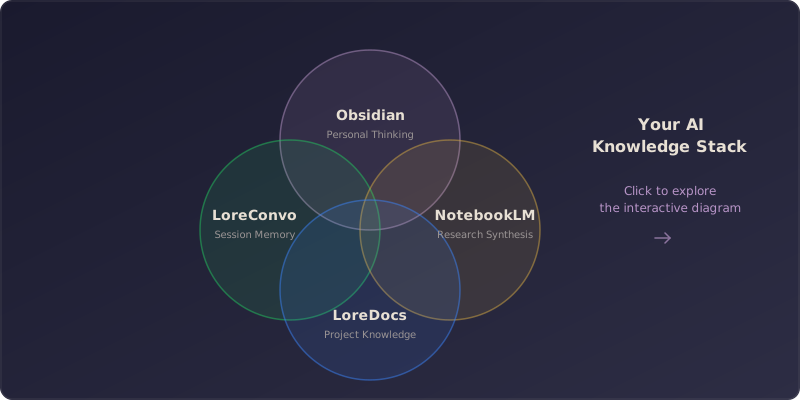
Obsidian owns this quadrant. It is designed for thinking-in-writing. The folder structure is yours to build. Tags and links emerge as you write, not enforced upfront. When you are thinking, you do not want to argue with a tool about where to file something. You want to write and organize later.
Quadrant 2: Consumed Knowledge. External research documents, transcripts, academic papers, documentation from other projects. Knowledge that you did not create, but need to digest, annotate, and reference. You are consuming and synthesizing, not creating from scratch.
NotebookLM owns this quadrant. It digests PDF, text, audio, and video. It creates summaries, highlights key points, generates follow-up questions, and surfaces cross-document themes. You can talk to your research library and ask it questions. The interface is streamlined for consuming, not for creating. NotebookLM excels at "here is a stack of documents -- help me understand them."
Quadrant 3: Shared Team Knowledge. Technical decisions, architectural standards, operational runbooks, deployment procedures. Knowledge that your team has made together and that everyone needs to follow. This knowledge must stay current, must be version-controlled, and must have a single source of truth. It is not collaborative writing (Docs), not personal thinking (Obsidian), not external research (NotebookLM). It is canonical knowledge that changes over time.
LoreDocs owns this quadrant. It is designed for technical knowledge that must stay current and machine-retrievable. Vaults organize knowledge by topic, not by folder guessing. Documents are versioned and tagged. When you ask Claude "what is our current deployment procedure?" Claude retrieves the actual procedure from your Deployment Runbook vault, not a summary or paraphrase. Not the version from six months ago. The current one.
Quadrant 4: Collaborative Writing and Creation. Documents you are creating together with teammates. Meeting notes, design documents that are still being debated, early-stage PRDs, proposals. Knowledge that is in flux and that benefits from multiple people commenting and suggesting changes.
Google Docs, Notion, or Confluence own this quadrant (depending on your preference). These tools are designed for collaborative editing, comments, version tracking via edit history, and discussion threads. When something moves from "being debated" to "we have decided" it can graduate to LoreDocs for canonicalization.
A Concrete Example
You are designing a new data pipeline architecture. Here is how knowledge flows across all four quadrants:
Start in Obsidian (Quadrant 1). You capture initial ideas. Partition strategy options. Trade-off notes. Questions about whether incremental loads should use CDC or event sourcing. Rough sketches. Stream of consciousness. No structure yet. You write "should we version the schema?" and tag it #schema-design #open-question.
Move to Docs/Confluence (Quadrant 4). You write a design document and share it with the team. They comment. Someone suggests event sourcing instead of CDC. Someone else links to a paper on immutable event streams. The document evolves over two weeks as the team discusses and debates.
Consume external knowledge in NotebookLM (Quadrant 2). The team member uploads five papers on event sourcing. You use NotebookLM to ask "what are the downsides of event sourcing for this use case?" NotebookLM synthesizes across all five papers and surfaces the trade-offs. You take those insights back to the design document.
Canonicalize in LoreDocs (Quadrant 3). After two weeks of debate, you have decided: yes, event sourcing, with a CDC fallback for edge cases. You write the final decision document: "Event Sourcing Pattern for Incremental Loads (v1, April 2026)." You add it to the Architecture vault in LoreDocs. You tag it with custom labels: current, decision-final, no-changes-expected-for-6-months.
Claude retrieves from LoreDocs. The next time you (or a teammate, or an autonomous agent) ask Claude "what is our approach to incremental loads?" Claude pulls the current decision from the Architecture vault. Not the design document from April that is now outdated (it is still in Docs, where you left it). Not your raw thinking from Obsidian. The canonical, versioned, team-decided procedure.
The Key Insight: No Duplication, Clear Ownership
The reason this works is that each tool handles what it was designed for, and no knowledge lives in two places.
Your personal thinking stays in Obsidian. When you are done thinking and the team is done debating, it does not stay there. You do not maintain two parallel versions of the decision -- one in Obsidian and one in LoreDocs. The moment something becomes canonical (team decision, architectural standard, operational procedure), it lives in LoreDocs. Obsidian is for exploration, not for long-term reference.
Similarly, NotebookLM is for consuming external knowledge. You do not copy your NotebookLM summaries into LoreDocs or Obsidian. You use NotebookLM to learn from external sources, then take the insights and write your own decision document for LoreDocs.
And Docs/Confluence is for the discussion, not the decision. Once the team has decided, the debate ends, and the decision graduates to LoreDocs. You might leave the Docs comment thread open for historical context ("here is where we discussed this"), but the canonical reference is in LoreDocs.
Why This Matters for AI Workflows
If you work with Claude (in Code, in Cowork, or in the chat interface), the knowledge quadrants matter even more.
Claude excels when given the right context at the right time. If you load a vault from LoreDocs at the start of a session, Claude sees your actual current architectural decisions and reasons with them. If you instead give Claude a summary you wrote, or ask Claude to search your Obsidian vault, Claude works from second-hand knowledge. The farther removed from the source, the worse Claude's reasoning.
LoreDocs is built specifically for this use case: you create the knowledge, tag it as current, and Claude retrieves it directly. No summarization. No paraphrase. No guessing which version is authoritative.
If you run autonomous agents, this clarity becomes critical. When the builder agent and the QA agent both need to know the current architecture, they should both read the same canonical documents from LoreDocs -- not reconcile differences between your Obsidian, Confluence, and Docs.
See the Full Picture
We built an interactive diagram that maps these four quadrants visually -- showing which tool owns each space and where the overlaps are. Click the image below to explore it.
Getting Started
If you already use Obsidian, you have Quadrant 1. If you consume research documents, NotebookLM handles Quadrant 2. If you use Docs or Confluence, Quadrant 4 is covered. The missing piece for most technical teams is Quadrant 3 -- the canonical knowledge layer where decisions become architectural standards.
That is where LoreDocs fits. It is not a replacement for your other tools. It is the layer that turns team decisions into machine-retrievable standards.
Start small. Create one vault for architectural decisions on your current project. Document the three or four major decisions your team has already made. Tag them with current and canonical. Then ask Claude to load that vault at the start of your next session and see what happens when Claude reasons from your actual decisions instead of general knowledge.
That clarity compounds across a project.
Explore LoreDocs on the tools page
Labyrinth Analytics helps organizations navigate complex data systems. Learn more about building knowledge-driven teams at labyrinthanalyticsconsulting.com.